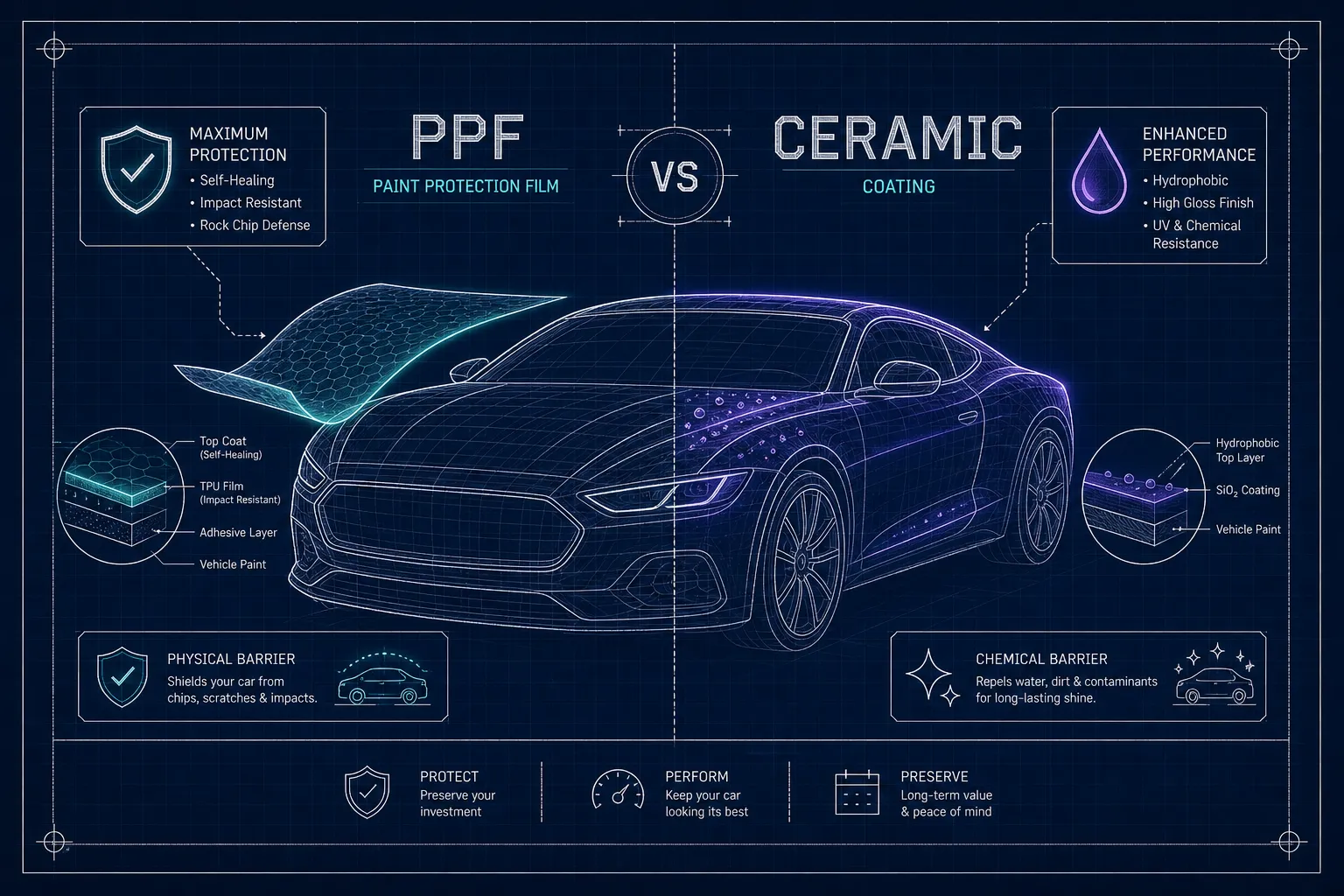
If you're asking yourself, "Should I get PPF or ceramic coating for my car?", you're already asking the right question. The honest answer is that these two products don't compete with each other because they solve completely different problems. One stops a rock chip. The other stops a bird dropping from etching into your clear coat. Treating this as a head-to-head competition means you'll optimize for the wrong threat, and end up under protected where it counts.
At Shine & Protect, this is one of the most common questions we hear from vehicle owners looking to protect their investment. Whether you should get PPF or ceramic coating for your car depends on how you drive, where you park, and what your paint is actually exposed to every day. The answer isn't always the same, and it shouldn't be.
This article walks through how each protection works, where each one falls short, what installation costs look like in 2026, and the questions you need to ask any installer before you hand over your keys.
What PPF and Ceramic Coating Actually Protect Against
These two products operate on entirely different principles, and understanding that distinction makes every other decision easier. Paint protection film, sometimes called clear bra, is a thermoplastic urethane film measuring 150 to 200 microns thick. It absorbs and deflects physical impacts before they ever reach your paint. Ceramic coating, by contrast, chemically bonds to your clear coat at the molecular level, creating a semi-permanent hydrophobic layer. One is a physical shield. The other is a chemical bond.
Self-Healing Technology
PPF's defining feature is its self-healing technology. When light scratches or swirl marks occur, heat — whether from sunlight, warm water, or engine warmth — activates the film's polymer chains and allows surface defects to reflow and disappear. In warm conditions, this happens in 15 to 30 minutes. In cold Pennsylvania winters it's slower, but the same mechanism works once the vehicle warms up. No other product category does this.
Nano ceramic coating excels at an entirely different set of threats. It repels water, resists UV oxidation, and blocks chemical contamination from bird droppings, tree sap, and acid rain. What it cannot do is stop a rock chip. A piece of highway debris will punch straight through a ceramic coating because the coating adds no measurable impact resistance. This is not a flaw in the product; it simply wasn't designed for that purpose.
Should I Get PPF or Ceramic Coating for My Car? When PPF Is the Right Answer
If you drive highway miles regularly, live near construction zones, travel gravel roads, or deal with Pennsylvania winters and road salt, PPF is the only product that addresses those threats directly. Road salt accelerates oxidation dramatically, and once it reaches bare metal through a rock chip or a paint crack, rust forms in days rather than months. A film barrier prevents that contact entirely. For drivers in Bucks County and Lehigh Valley, where winter road crews salt heavily, front-end coverage pays for itself quickly.
Rock chip protection is PPF's exclusive territory. No ceramic coating, sealant, or wax provides meaningful impact resistance. PPF's self-healing properties also handle light abrasion from car wash equipment, parking lot brushes, and low-hanging branches (the kind of minor daily damage that accumulates into a dull, scratched finish over a few years of ownership).
New vehicles, luxury sedans, and electric vehicles benefit most from front-end or full-vehicle PPF coverage. EVs in particular tend to have softer factory paint that shows damage more readily, for specific guidance on protecting Teslas, see our Tesla PPF installation information. A documented PPF installation also strengthens your resale position: buyers and dealers recognize the film as evidence of a vehicle that was actively protected, not just occasionally washed.
Coverage Level Tip
Coverage level is a budget decision, not a quality one. A partial front kit covering the hood leading edge, little front fenders pieces, bumper, and mirrors costs between $600 and $1,500 and handles the zones that take the most highway impact. A full front-end package runs $2000 to $3,500 and adds both fenders, headlights, and complete hood coverage. Neither is a compromise on protection quality; they simply address different surface areas.
When Ceramic Coating Makes More Sense
Chemical and UV threats operate on a different timeline than rock chips, but they're just as damaging over the long term. UV radiation oxidizes clear coat steadily, causing color fade that no amount of polishing fully reverses. Bird droppings and tree sap can begin etching into an unprotected surface within hours, especially in summer heat. Ceramic coating addresses both threats more effectively than PPF alone.
The hydrophobic surface that ceramic coating creates isn't just satisfying to watch. Dirt doesn't bond as aggressively to a coated surface, which means every wash is faster and less abrasive. Water beads and rolls off rather than sitting and evaporating, reducing water spot formation. For owners who want to maintain a showroom finish with less effort, this is the coating that delivers that outcome — see examples of finished work in our gallery.
Garage-kept vehicles, show cars, and lower-mileage weekend drivers face fewer physical impact threats but still need UV and chemical defense every time the car sits outside. Ceramic coating applied over an existing vinyl or factory wrap also extends film life significantly by adding a sacrificial chemical barrier on top. For budget-conscious owners who need whole-car coverage but can't justify full-vehicle PPF costs, a professional-grade ceramic coating covers the entire vehicle capably.
Top-tier professional ceramic coatings last five to eight years with correct maintenance, a pH-neutral wash every two to four weeks and a ceramic booster spray every three to six months. Without that routine, even a premium coating underperforms its rated lifespan. Entry-level coatings last one to two years; mid-tier products run two to five years. The product tier matters, but maintenance discipline matters just as much.
The Case for Combining Both on the Same Car
PPF and ceramic coating are not competing products. They're complementary. When layered correctly, they cover every threat category simultaneously: physical impact, UV radiation, chemical etching, and abrasion. Most luxury and performance vehicle owners ultimately choose this approach, and it's the one we recommend at Shine & Protect for any vehicle where long-term preservation is the goal.
Installation Order Matters
The installation sequence is non-negotiable. PPF goes on first, ceramic coating goes on top. Applying PPF over an existing ceramic coating creates adhesion failures: the hydrophobic surface interferes with the film's adhesive bond, leading to edge lifting and premature peeling. The correct process is PPF installation followed by a 24- to 72-hour cure period, then a full ceramic coating application. The coating amplifies the film's chemical resistance and gloss while the film continues handling physical impacts underneath.
Full combo packages (Full Vehicle PPF and Ceramic coating) for a standard vehicle typically run $6,000 to $10,000 or more depending on coverage and vehicle size. Exotic and premium vehicles run higher, often $8,500 to $20,000 for full-vehicle PPF alone. The more accessible middle-ground strategy is full front PPF combined with full-vehicle ceramic coating, which runs approximately $3,500 to $5,500 for most vehicles. This approach protects the highest-impact zones with film while giving the entire car chemical and UV defense. For most owners, that combination delivers the best outcome per dollar spent.
PPF vs. Ceramic Coating: Real Cost and Lifespan Expectations
Here are the actual numbers by coverage tier, based on what reputable shops charge in 2026:
| Protection Type | Price Range | Coverage / Lifespan |
|---|---|---|
| Partial Front (Chip Kit) | $600 – $1,500 | Hood leading edge, little front fenders pieces, front bumper, and mirrors |
| Full Front-End PPF | $2,000 – $3,500 | Complete hood, both fenders, bumper, headlights, and mirrors |
| Full-Vehicle PPF | $3,500 – $10,000 | Standard sedans and SUVs; $6,500 – $20,000 for premium and exotic vehicles |
| Ceramic Coating (Silver) | Starting at $499 | 1 to 2 year lifespan; requires more frequent reapplication |
| Ceramic Coating (Gold) | Starting at $899 | 2 to 5 years; suitable for most daily drivers with a consistent wash routine |
| Ceramic Coating (Platinum) | Starting at $1,399 | 5 to 8 years; the ceiling for professional-grade products with correct prep and maintenance |
Prices depend on:
- Vehicle Size
- Paint Condition
- Amount of Paint Correction Required
These ranges hold across most reputable Pennsylvania shops, though surface condition, vehicle size, and film brand will shift the final number.
When evaluating film brands provides manufacturer warranty is a useful benchmark. It covers yellowing, cracking, blistering, and delamination, and it's registered to the vehicle's VIN for transferability. That transferability matters when you sell: a documented warranty attached to the VIN is a concrete asset, not just a sales pitch. For a deeper look at typical warranty coverage and what is usually included, read this overview of what a PPF warranty covers.
One factor that doesn't show up in pricing comparisons is the cost of skipping paint correction before installation. Any existing swirl marks, scratches, or contamination on the clear coat will be locked in permanently under the film or coating. Professional installers who care about the outcome will assess the paint condition before quoting and will recommend correction if the surface needs it. Those who skip that step are cutting a corner that shows up later, for more on why paint correction is necessary before coating, see this explanation on why paint correction matters.
Questions to Ask Your Installer Before You Book
Warranty terms are the fastest way to evaluate whether a shop operates at a professional level. Ask whether the manufacturer warranty covers yellowing, delamination, and self-healing failure. Ask whether it's registered to the vehicle's VIN so coverage transfers if you sell the car. Any reputable shop will tell you upfront what the standard exclusions are: automatic car washes, harsh chemicals, and impact damage. If they don't bring this up, ask directly.
A quality installer also assesses your situation before recommending a package. That means asking about your daily commute, where you park, how often you wash the car, and what your coverage goals are. At Shine & Protect, every consultation includes a walkthrough of the vehicle's vulnerable zones, a coverage recommendation based on actual driving patterns, and a clear breakdown of what the chosen package protects, and what it doesn't. That last part matters: no package covers everything, and an honest installer tells you exactly where the gaps are.
If an installer skips this conversation and just quotes you a price, that's a red flag. Proper installation of either product requires understanding what the vehicle will face after it leaves the shop. A shop that doesn't ask those questions isn't thinking about your long-term result.
Should I Get PPF or Ceramic Coating for My Car? Making the Right Call
Once you separate the two threat categories, the decision gets much cleaner. PPF handles physical protection: rock chips, road debris, scratches, abrasion, and winter road salt. Ceramic coating handles chemical and UV protection: bird droppings, oxidation, gloss retention, and ease of cleaning. Combining both gives you complete coverage, and it's the right call for any vehicle you care about preserving long term.
Your budget sets the coverage tier, not the overall approach. Even a partial PPF package covering the high-impact front zones, paired with a full-vehicle ceramic coating, is dramatically better than leaving factory paint exposed. The factory clear coat was never designed to survive five to ten years of highway miles, Pennsylvania winters, and chemical exposure on its own.
Still asking yourself whether you should get PPF or ceramic coating for your car? That conversation starts at Shine & Protect. No pressure, no one-size-fits-all packages, just a clear look at your vehicle's vulnerabilities and a recommendation that matches your driving habits and budget. Reach out to schedule a consultation, and we'll walk you through exactly what protection makes sense before we ever pick up a squeegee.